




Market Overview & On-Chain Context
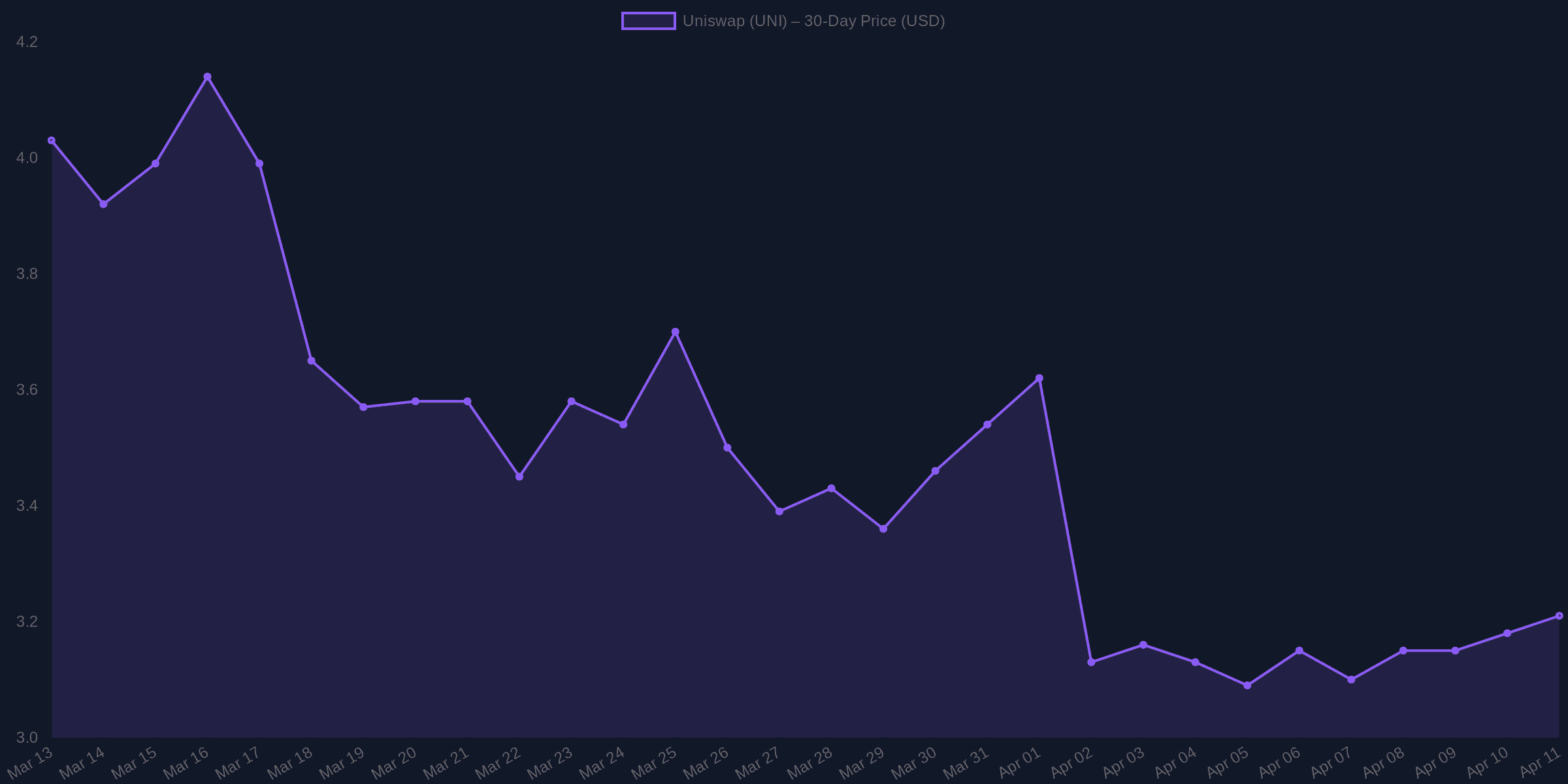
Uniswap (UNI) currently trades at $3.04 USD, reflecting a 5.39% decline over the past 24 hours. With a market cap of $1,923,512,979, Uniswap ranks 44th among cryptocurrencies. The 24-hour trading volume stands at $157,917,632, indicating a moderately active market. Despite these figures, the token is down 93.23% from its all-time high of $44.92. Over the past month, UNI has seen a significant decline of 24.71%, pointing towards a bearish trend that is worth analyzing.
Technical Analysis Deep Dive
Analyzing the technical indicators, the RSI-14 for Uniswap is at 37.52, suggesting that the token is approaching oversold territory. The MACD line is at -0.019659, with the signal line at -0.008494, and a histogram of -0.011165, which indicates bearish momentum. The Bollinger Bands show an upper band of $3.2125 and a lower band of $3.0365, with the price currently trading near the lower band, suggesting potential volatility. The 24-hour high and low are $3.21 and $3.02, respectively, indicating a narrow trading range in the short term.
Support, Resistance & Key Price Zones
Currently, Uniswap finds support at $3.03, which has held firm amidst recent declines. Resistance is identified at $4.16, a level that UNI needs to break to initiate a potential upward trend. Traders should watch these levels closely, as breaking past these zones could signal significant price movements. A breach below the support could see the price testing new lows, while overcoming resistance might lead to a recovery rally.
Fundamental Analysis
Uniswap remains a pioneering decentralized exchange in the DeFi space, known for its automated market-making protocol. Despite the recent price downturn, the platform continues to be a cornerstone for decentralized trading, with ongoing developments and upgrades aimed at increasing efficiency and reducing transaction costs. The growth of the DeFi ecosystem and the adoption of Layer 2 solutions could positively impact Uniswap’s utilization and, consequently, its token value.
Macro & Market Sentiment
The broader cryptocurrency market has been experiencing volatility, with regulatory concerns and macroeconomic factors influencing investor sentiment. Uniswap’s performance is closely tied to the overall health of the DeFi market, which has been under scrutiny but also shows resilience with new innovations. Market participants remain cautious, balancing between regulatory developments and the potential for technological advancements driving future growth.
Risks & Opportunities
Investing in Uniswap carries risks, including regulatory challenges and competitive pressures within the DeFi space. However, opportunities arise from its strong brand presence and potential for increased adoption as decentralized finance continues to evolve. Investors should weigh these factors carefully, considering both the potential for high rewards and significant risks.
Conclusion
Uniswap’s current price trajectory presents both challenges and opportunities for investors. While the technical indicators suggest caution due to bearish momentum, the platform’s fundamental strengths and market position offer potential for future gains. Monitoring key support and resistance levels, along with staying informed about market developments, will be crucial for navigating Uniswap’s price movements in the coming months.
Disclaimer: This article is for informational purposes only and does not constitute financial advice. Always do your own research before making investment decisions.
FAQ
What is the current price of Uniswap?
As of April 12, 2026, the current price of Uniswap (UNI) is $3.04 USD.
What are the key technical indicators for Uniswap?
The RSI-14 is at 37.52, indicating oversold conditions, while the MACD suggests bearish momentum with a histogram of -0.011165.
What are the support and resistance levels for UNI?
Uniswap has support at $3.03 and resistance at $4.16, key levels to watch for potential price movements.
What factors influence Uniswap’s price?
Uniswap’s price is influenced by market sentiment, DeFi adoption rates, regulatory developments, and overall cryptocurrency market trends.
